Putna Monastery
Stephen the Great’s necropolis and symbol of Romanian faith
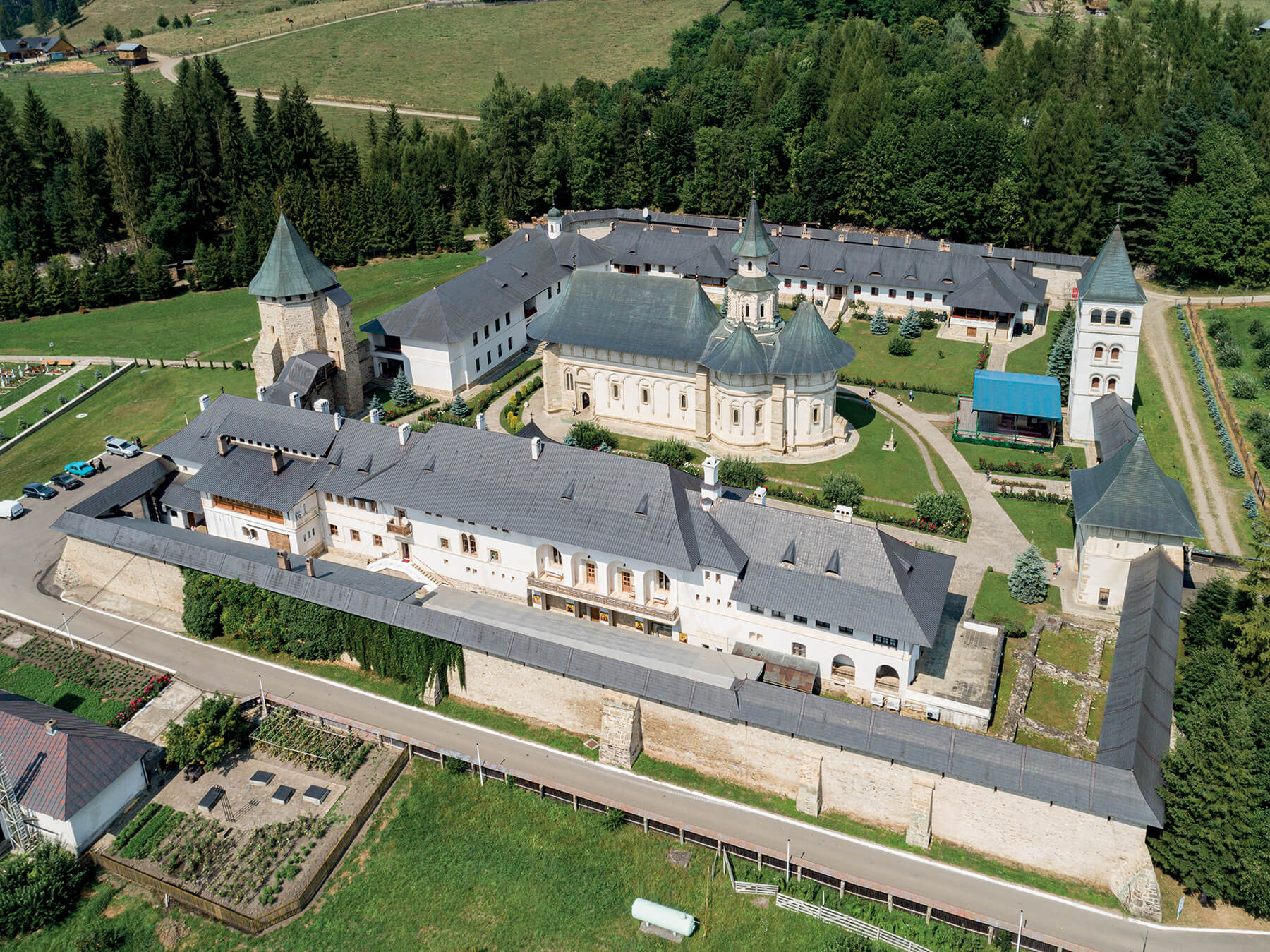
Located in the north of Suceava County, close to the border with Ukraine, Putna Monastery is one of the most important foundations of Stephen the Great and one of the most representative monuments of Romanian spirituality. Considered a true symbol of national identity, Putna is the resting place of the great ruler of Moldova.
The founding of the monastery
Putna Monastery was founded by Stephen the Great in 1466, shortly after the victory at Chilia. The construction of the church was completed in 1469, and the consecration took place in 1470.
Legend has it that the site of the monastery was chosen by the ruler himself, who allegedly shot his bow from a nearby hill, and where the arrow fell, he decided to build the church.
The church was dedicated to the “Assumption of the Virgin Mary” and quickly became one of the most important religious, cultural and artistic centers of medieval Moldova.
The princely necropolis
Putna is best known as the resting place of Stephen the Great, who was buried here in 1504. On his simple and imposing tombstone, the name of the great voivode is engraved.
Several members of the princely family are buried alongside Stephen the Great, including:
- Maria Voichița, one of the prince’s wives
- Bogdan III, his son and successor to the throne
- Maria de Mangop, another wife of the voivode
Thus, the monastery became the princely necropolis of medieval Moldova.
Architecture and transformations over time
The original construction underwent changes over the centuries, following fires and destruction. In the 17th century, during the reign of Vasile Lupu, the church was restored and partially rebuilt.
The current architecture preserves the Moldavian style specific to the era of Stephen the Great, with Byzantine and Gothic elements harmoniously combined. The monastic ensemble is surrounded by strong enclosure walls, which give the monastery the appearance of a medieval fortress.
Cultural and spiritual center
During the medieval period, Putna Monastery was an important cultural center. A school of calligraphers and miniaturists operated here, and the manuscripts produced at Putna are considered true masterpieces of Romanian medieval art.
Also, the embroideries and liturgical objects preserved in the monastery’s treasury demonstrate the high artistic and spiritual level of the era.
Putna and the rebirth of national consciousness
In 1871, 400 years after the monastery’s consecration, the “Putna Festival” took place here, an event of great importance for the Romanian national movement. Among the participants were Mihai Eminescu and Ioan Slavici.
The event transformed Putna into a symbol of Romanian unity and identity.
Heritage and current importance
Today, Putna Monastery is an important pilgrimage site and one of the most visited monasteries in Romania. It continues to be a vibrant center of monastic and spiritual life.
Through its history of over five centuries, through its cultural role and through its close connection with the figure of Stephen the Great, Putna Monastery remains a fundamental monument of Romanian heritage and identity.
Location and access
Eridor Chalet is located in an accessible area of Bucovina, offering quick connections to the region’s main tourist attractions. The property is approximately 77 km from Putna Monastery, one of the most important historical and spiritual monuments of Moldova.
The distance can be easily covered by car, offering tourists the possibility of a day trip to this symbolic place, while maintaining the comfort and tranquility offered by accommodation at Eridor Chalet.
Photo source: www.putna.ro