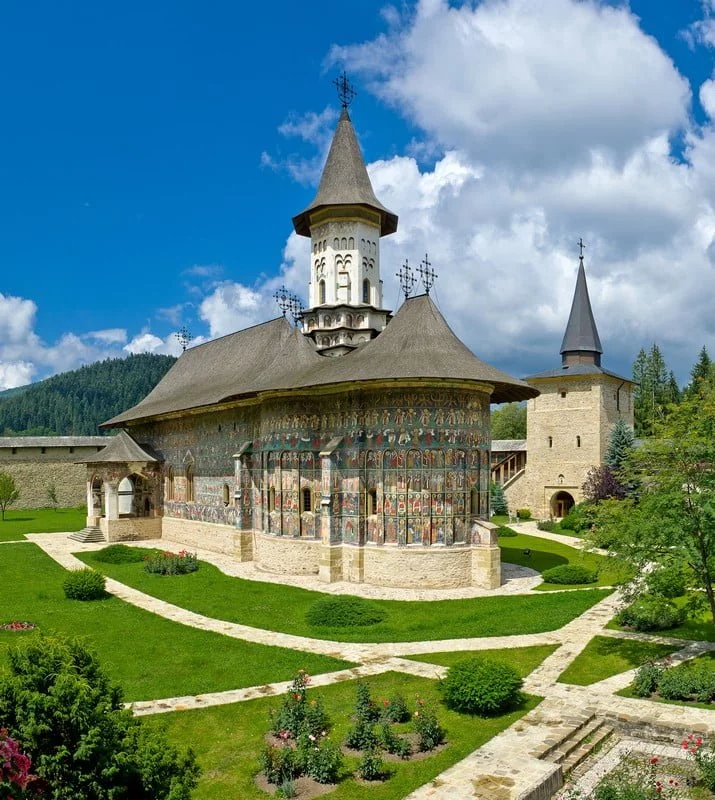
Sucevita Monastery
Fortress of faith and masterpiece of Moldovan medieval art
Located in Sucevita commune, Suceava county, at the foot of the Bucovina Mountains, Sucevita Monastery is one of the most impressive painted monasteries in northern Moldova. Remarkable for its combination of fortification architecture and exceptional exterior painting, Sucevita is part of the UNESCO World Heritage Site, being included in the ensemble of “Painted Churches of Northern Moldova”.
The founding of the monastery
The Sucevița Monastery was built at the end of the 16th century, between 1582–1584, at the initiative of the Movilești family, one of the most important boyar families of the time. The main founders were the brothers Gheorghe Movilă (metropolitan of Moldova) and Ieremia Movilă (lord of Moldova).
The monastery church is dedicated to the “Resurrection of the Lord” and was conceived not only as a place of worship, but also as a necropolis for the Movilești family.
Architecture – monastery and fortress
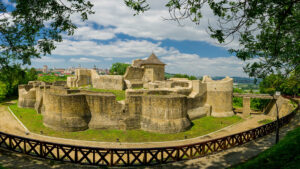
Sucevita impresses with its massive enclosure walls, equipped with corner towers and buttresses, which give it the appearance of a medieval fortress. The monastic ensemble is one of the best preserved in Bucovina.
The church is built in Moldavian style, with Byzantine and Gothic influences, and preserves the characteristic elements of the era: closed porch, nave, narthex and tomb chamber. The harmonious proportions and elegance of the architectural details contribute to the artistic value of the monument.
Interior and exterior painting
The church painting was made in 1595 and is attributed to the brothers Ioan and Sofronie, Moldavian painters of the era.
The exterior frescoes are among the best preserved in Bucovina and are notable for the dominance of the emerald green color, specific to Sucevita. The iconographic program is complex and rich in theological meanings.
The most famous representation is the “Ladder of the Virtues” scene, painted on the northern facade. This illustrates man’s spiritual ascent to God, symbolized by a ladder that believers climb, helped by angels, while devils try to pull them down.
Other important scenes include:
- “The Last Judgment”
- “The Tree of Jesse”
- “The Burning Prayer”
- “The Life of Saint John the New”
The painting from Sucevita represents one of the last great achievements of medieval Moldavian art.
Cultural and historical role
The monastery was an important cultural and spiritual center during the Movilești period. Here manuscripts were copied and religious objects of great artistic value were made.
Over the centuries, Sucevita went through periods of trials, including during the Habsburg occupation, but it continued to function as a monastery, preserving its monastic life.
UNESCO heritage and current importance
In 2010, the Sucevita Monastery was included in the UNESCO World Heritage List, along with the other painted churches in northern Moldova.
Today, Sucevița is one of the best preserved fortress-monasteries in Romania and an important tourist attraction and pilgrimage site. Through its architectural harmony, the richness of its paintings and its historical value, the Sucevita Monastery remains an emblematic monument of Romanian culture and spirituality.
Location and access
Eridor Chalet is conveniently positioned for exploring the most important attractions in Bucovina. The property is approximately 59 km from Moldovita Monastery, a UNESCO World Heritage Site and famous for its exterior painting.
The distance can be easily covered by car, offering tourists the opportunity for a relaxing trip through the picturesque landscapes of Bukovina, returning to the comfort and tranquility offered by Eridor Chalet.
Photo source: www.visitingbucovina.ro/