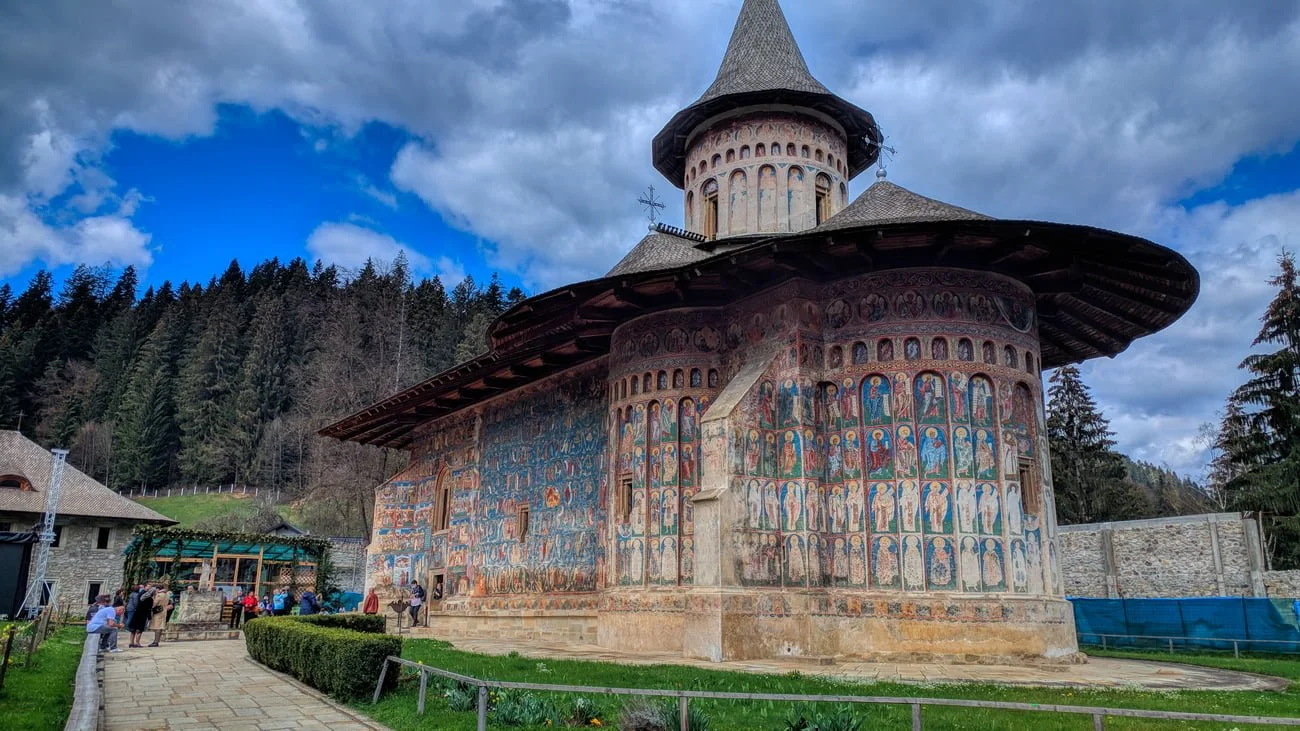
Voronet Monastery
History, legend and universal heritage
Located in the heart of Bucovina, near Gura Humorului, the Voroneț Monastery is one of the most valuable foundations of Stephen the Great and one of the most important monuments of medieval art in Romania. Known throughout the world for the famous “Voroneț Blue” and for the impressive fresco of the “Last Judgment”, the monastery represents a true synthesis between faith, art and history.
The legend of the foundation
Tradition says that in 1476, after the defeat suffered by the Turks at Războieni, Stephen the Great was deeply troubled and worried about the fate of Moldova. In those difficult moments, he went to seek the advice of Daniil the Hermit, a wise monk who lived in seclusion in a cell carved into the rock, near the current monastery.
Stephen asked for his advice, and Daniil encouraged him not to give up the fight and to have faith in God. Strengthened in spirit, the prince reorganized his army and continued the resistance against the Ottomans.
After the victory, as a thank you for divine help, Stephen the Great decided to build a monastery on that site. Thus, in 1488, the Voroneț Monastery was built, in a remarkably short time – approximately three months and three weeks.
Stephen the Great’s Foundation
The monastery church, dedicated to “Saint George the Great Martyr”, was built in the Moldavian style specific to the era of Stephen the Great, combining Byzantine and Gothic elements. The initial construction had a simple plan, and architectural elements were added later, including the closed porch (in the 16th century).
Voroneț quickly became an important religious and cultural center of medieval Moldova.
Exterior painting and the “Voroneț Blue”
In 1547, during the reign of Petru Rareș (son of Stephen the Great), the church was decorated with exterior paintings. It was then that the famous fresco of the “Last Judgment” was created, which covers the entire western facade.
The dominant color – the famous “Voroneț Blue” – became the symbol of the monastery. The intensity and durability of this shade have impressed historians and specialists from all over the world. Over time, the exact formula of the pigment has remained a subject of interest and mystery.
Due to its exceptional artistic value, Voronet is often nicknamed the “Sistine Chapel of the East”.
Periods of decline and revival
In 1785, during the Austrian occupation of Bukovina, the monastery was dissolved and the monastic community was removed. For over a century and a half, Voroneț functioned only as a parish church.
It was not until 1991 that the monastery was reestablished as a monastic settlement of nuns, regaining its spiritual and cultural role.
UNESCO Heritage
The Voroneț Monastery is part of the ensemble of “Painted Churches of Northern Moldova”, included in the UNESCO World Heritage List. This recognition confirms the universal value of the monument and its importance for European and world culture.
Today, Voroneț is one of the most visited tourist attractions in Romania, annually attracting thousands of pilgrims and tourists from all over the world.
The legacy of Voroneț
The Voroneț Monastery is not just a historical monument, but a symbol of Romanian identity. It represents the faith, resistance and artistic talent of an era of great significance for the history of Moldova.
Through its frescoes, its founding legend, and its architectural beauty, Voroneț continues to inspire generations and keep the memory of the past alive.
Location and access
Eridor Chalet is located in a quiet area, with easy access to the main tourist attractions in Bucovina. The property is about 3.2 km from Voroneț Monastery, one of the most important painted monasteries in northern Moldova.
Its positioning allows for quick travel to both the historical and cultural sites in the area, as well as to the city center of Gura Humorului. Eridor Chalet offers modern accommodation conditions, quality services and a comfortable environment, being suitable for both families and groups of friends or tourists in transit through Bucovina.
Photo source: www.viziteaza-romania.com